Free, No-Login NVIDIA SimReady Assets: 2,500+ Physics-Ready OpenUSD Models, Tested
Bottom line: this is a genuinely free, no-login, directly downloadable library of industrial-grade 3D assets. They are not empty shells — each asset carries joints, collision bodies, mass and three physics payloads, so it is usable for robot simulation, digital twins or plain 3D work. The cost is not in getting them; it is in filtering them: large files, scattered licenses, and easily-confused counts.
This post does three things the original article did not: it separates the four asset counts, tests whether the China mirror works, and runs the full download-to-import path locally — where it breaks at the very last step.
1. What this library is
On October 21 NVIDIA released the SimReady Central Library: "simulation-ready" OpenUSD assets covering industrial equipment, robots, medical devices, home appliances and lighting.
"Simulation-ready" is what separates it from an ordinary 3D asset store:
- Physics, not just geometry — rigid bodies, collision meshes, joints and mass are pre-configured (the surgical robot asset alone has 17 moving parts);
- Three physics payloads — PhysX, MuJoCo and Newton, one each, so robot simulation does not start from re-rigging;
- OmniPBR materials + 4K textures — renders are not grey models;
- Clear license — CC-BY-4.0 on the main repo: attribution is enough for commercial use.
The main repository lives on HuggingFace as nvidia/simready-assets, with a natural-language search page at nvidia-simready-central.hf.space.
2. Four numbers, four meanings
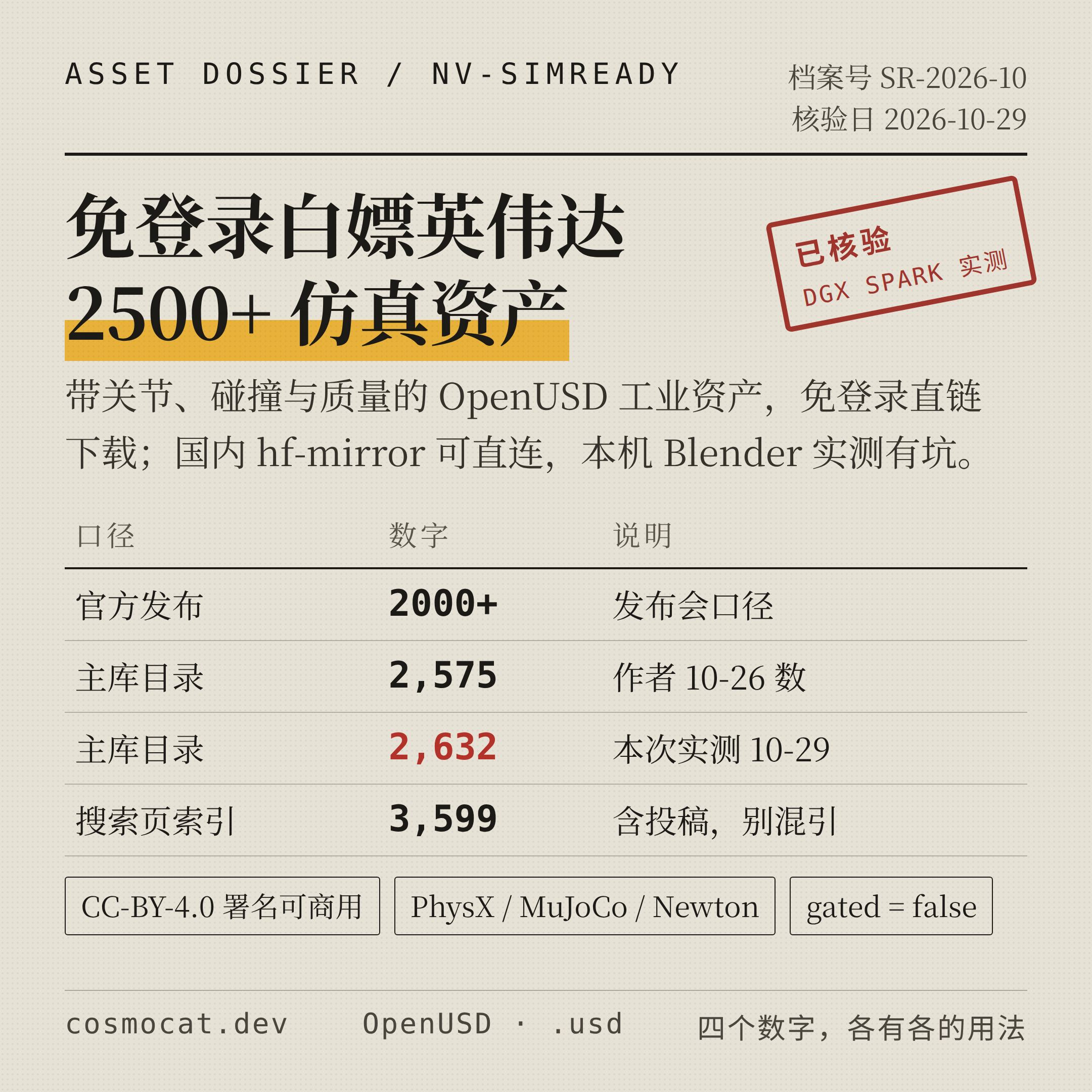
The most common mistake with this kind of resource is mixing up counts. There are four:
| What it counts | Number | Note |
|---|---|---|
| Official announcement | 2000+ | Most conservative |
| Main repo top-level folders | 2,575 | Author's count, Oct 26 |
| Main repo top-level folders | 2,632 | My count, Oct 29 — up 57 in three days |
| Search-page index | 3,599 | Includes submissions, not the repo total |
For writing or reporting, "2,500+" is safest; for precision say "2,600-odd folders in the main repo." Do not quote 3,599 as the asset total — it includes submitted content.
3. What is inside one asset
Open any asset folder:
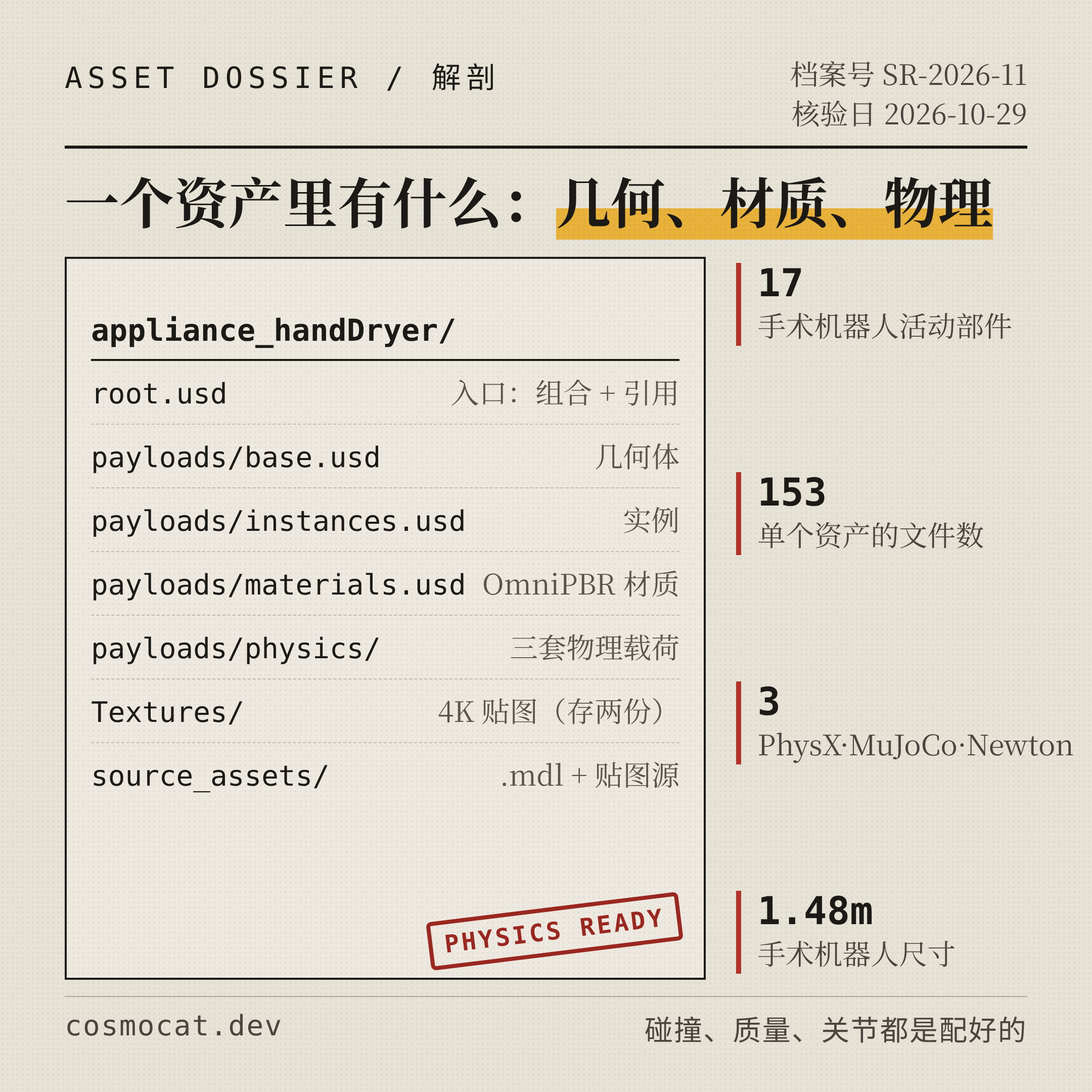
root.usdis the entry point that composes and references;payloads/is split by purpose:base.usdgeometry,instances.usdinstances,materials.usdmaterials,physics/physics;Textures/holds textures — 4K maps are stored twice (original plus optimized), which is part of why assets are large;source_assets/keeps the original.mdland texture sources for editing.
One asset can unpack into over a hundred files (153 in the example I inspected). It is an asset project, not a single model file.
4. Four steps, no login
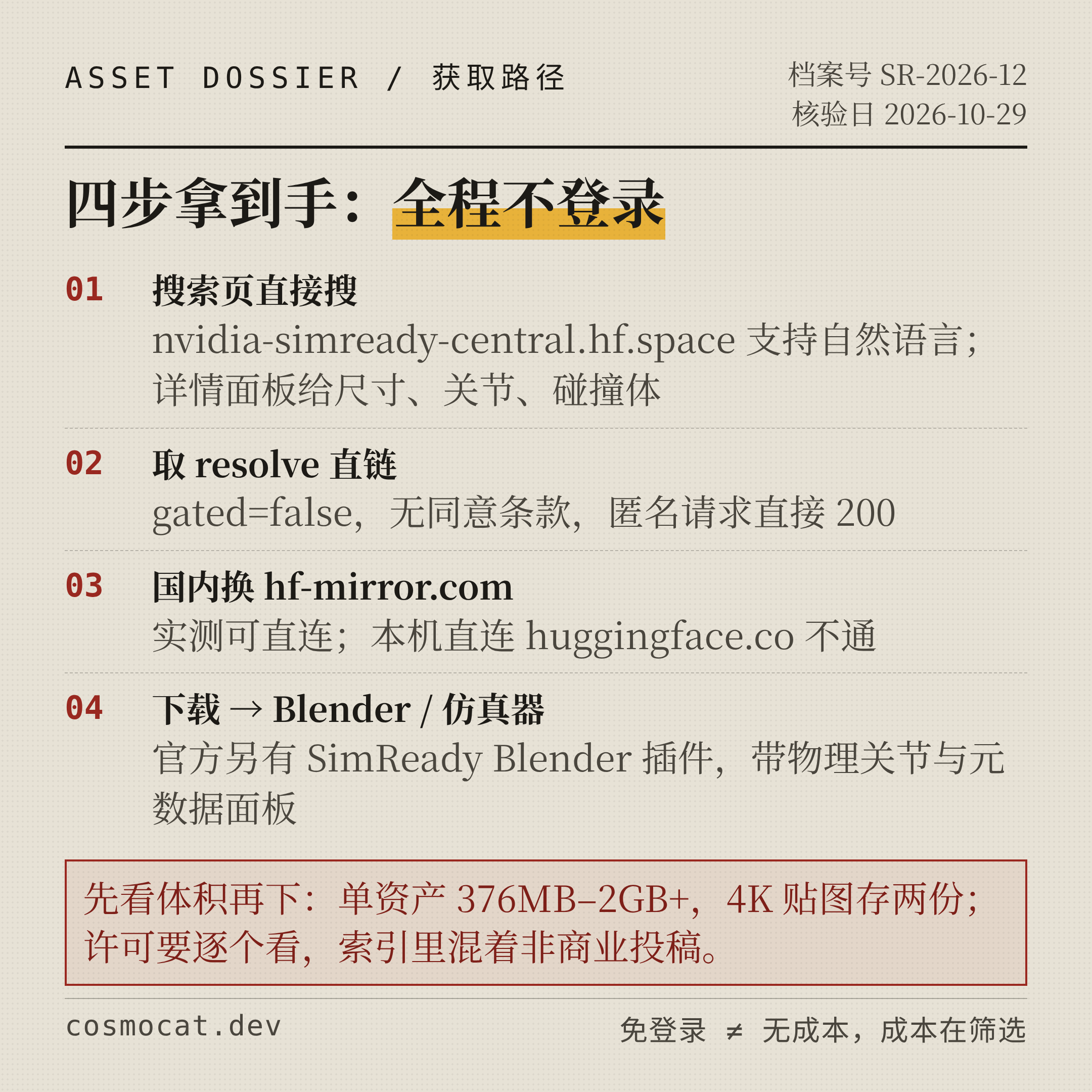
- Search on the search page —
nvidia-simready-central.hf.spacetakes natural language; result cards show Download size, and the detail panel lists dimensions, joint count, collision bodies and license; - Take the resolve link — the main repo is
gated=falsewith no consent step; anonymous requests return 200; - In China, switch to hf-mirror.com — the gap the original article left untested. I verified hf-mirror works directly: anonymous downloads of the LICENSE, thumbnails and USD files all succeeded. Direct access to huggingface.co fails from my machine, matching the author's experience;
- Import into Blender or a simulator — NVIDIA also ships a SimReady Blender add-on with physics-joint and metadata panels.
5. Local test: it works for the author, it broke on my machine
The author imported with headless usd_import in Blender 5.2.2 and rendered with Cycles CPU successfully (15 meshes, materials intact).
On my DGX Spark (ARM), following the same steps, I hit a wall: my Blender 4.0.2 was installed from unpacked debs and ships without a USD importer — no io_scene_usd add-on, and the bpy.ops.wm.usd_import operator simply does not exist.
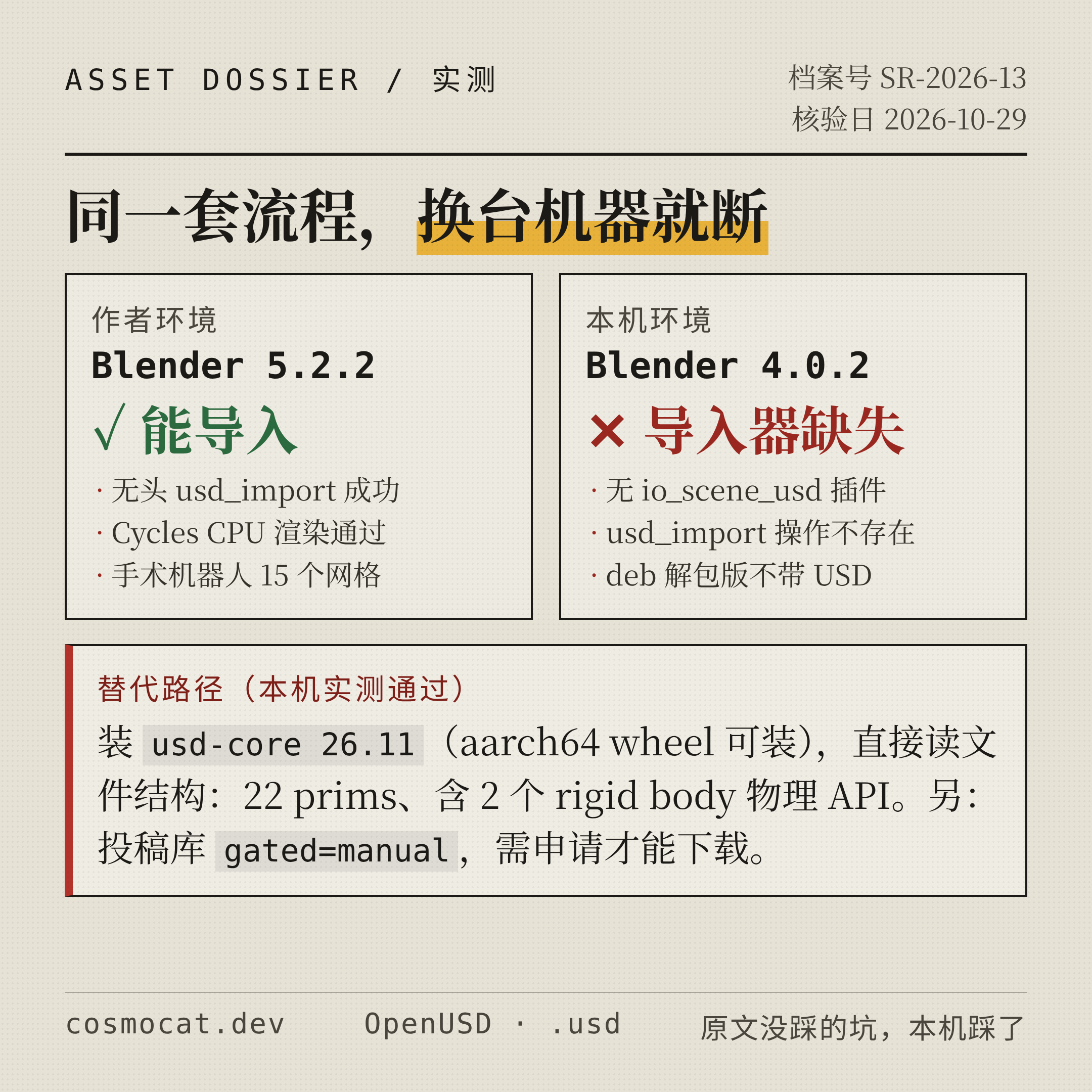
The workaround is usd-core: the aarch64 wheel installs fine and reads asset structure correctly (22 prims, including two rigid bodies with physics APIs, in the sample). Rendering still needs a Blender build with USD support, but at least "reading the file" is unblocked.
This is not the author's fault — it is an environment difference. If you write "tested and working," state the environment, or the next person will stall at the last step.
6. Boundaries worth knowing
- Size — 376MB to 2GB+ per asset is common; check Download size before clicking, and do not drag a whole category at once;
- License — the main repo is CC-BY-4.0, but license files are scattered inside each asset, and the search index includes non-commercial submissions — check the LICENSE before commercial use;
- The submission library is gated —
nvidia/simready-central-libraryisgated=manualand needs contributor approval; - Robot density is ambiguous — folder-name counts and search-page counts do not agree; count it yourself if you need a number.
7. Who it is for
- Robotics / embodied AI — props that work directly in MuJoCo and PhysX, saving modelling and physics setup;
- Digital twins / factory simulation — industrial and medical equipment are ready to use;
- 3D content creation — high-poly, commercially usable assets with CC-BY attribution.
One sentence: this is a rare "no login + physics-ready + commercially usable" industrial asset library, worth a bookmark. The real cost is filtering and verification, not access.
Links: