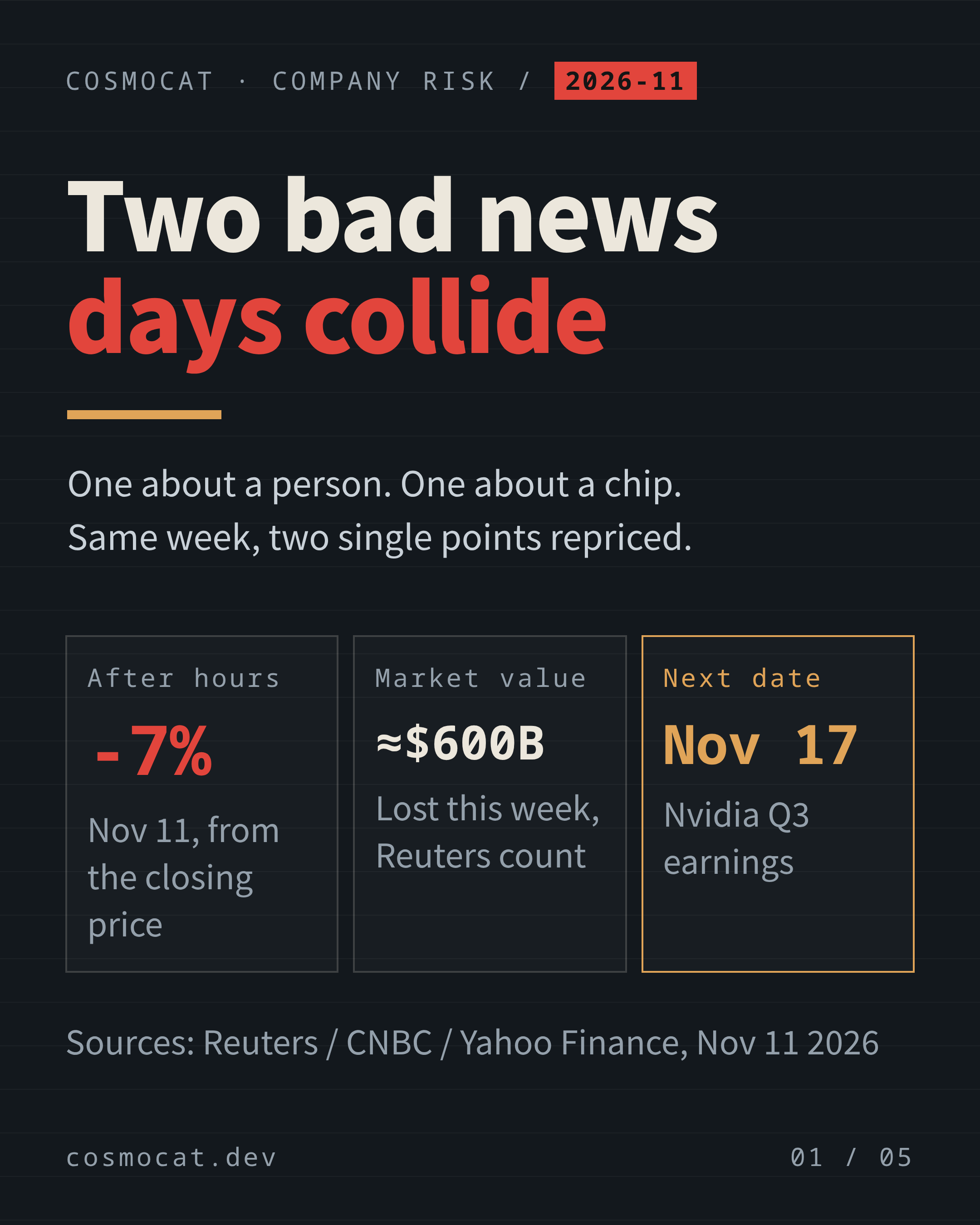
Nvidia closed November 11 up 2.87% at $173.73. A few hours later the after-hours price touched $161.64, down about 7%. Add the week's selling and the company had lost roughly $600 billion in market value, by Reuters' count.
Two stories drove the move. One was about a person. One was about a chip. They arrived on the same day, but their evidence is nowhere near the same quality, and the market repriced them at very different speeds.
What is confirmed, and what is still reporting
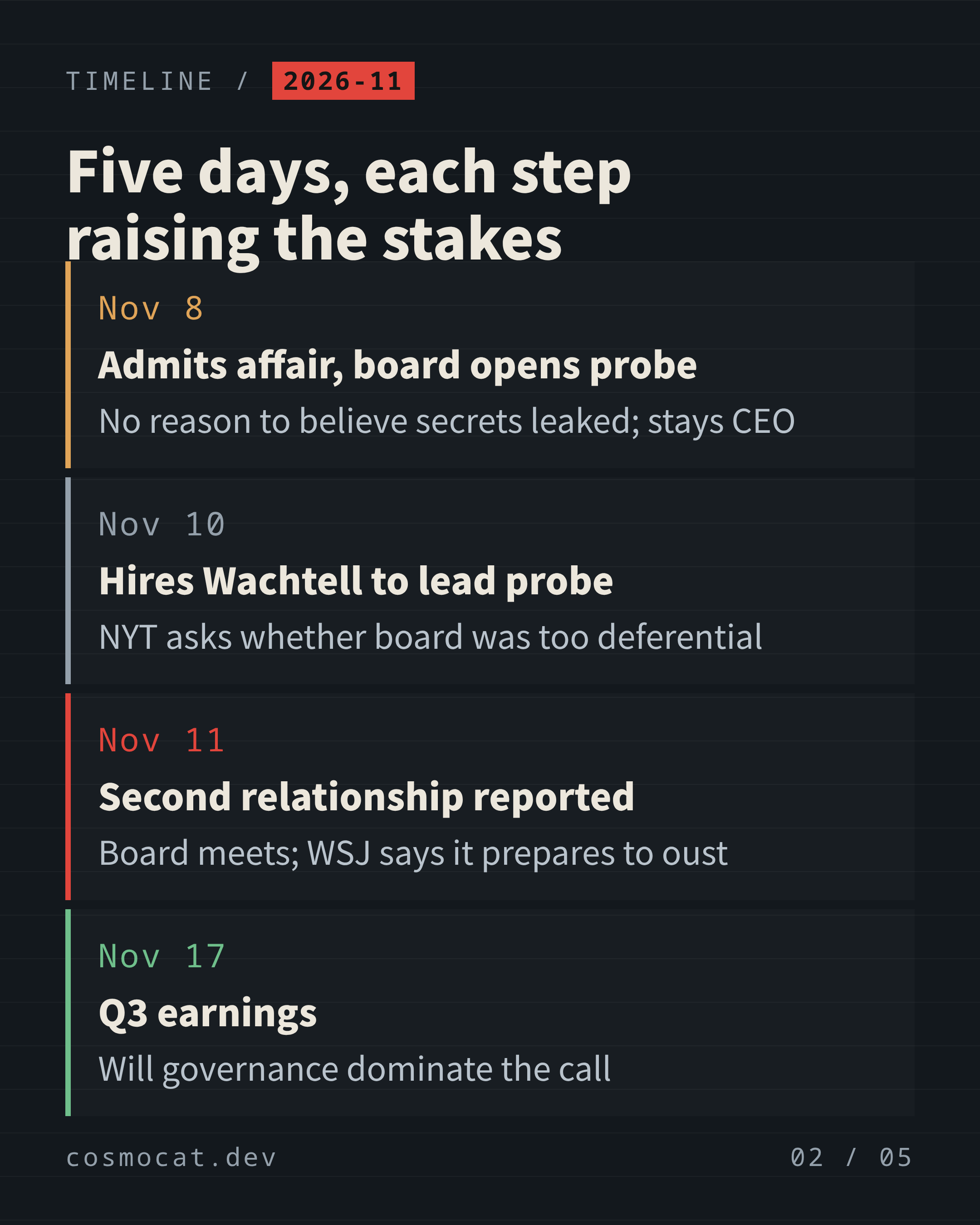
On November 8, Jensen Huang told employees he had been unfaithful to his wife and apologized publicly. The same day, Nvidia's board announced an independent investigation into recent reports about his relationship with a woman U.S. officials have described as a Chinese intelligence asset. The board said it had no reason to believe national security or company secrets were compromised, expressed confidence in Huang and his leadership team, and said he would remain CEO.
On November 10, the independent directors retained Wachtell, Lipton, Rosen & Katz, with former acting U.S. Attorney for the Southern District of New York Joon H. Kim leading the work. That same day, The New York Times published a piece on the board's history. The headline made the point that this board has generally let Huang run the company his own way.
On November 11, The Times reported a second relationship, with Kimberly Powell, 48, Nvidia's vice president of health care, who reports directly to Huang. The paper cited five current or former employees, all anonymous. Two of them said Huang and Powell were seen being affectionate at a San Jose hotel during the March GTC conference, and that a bystander filmed them. According to the report, Huang's security team isolated the person who filmed and offered a nondisclosure agreement. The Times said it had not seen the video.
Late that afternoon, The Wall Street Journal reported the board was preparing to oust Huang and could meet as soon as Wednesday to decide his future. Reuters confirmed with a separate source that the board was meeting Wednesday to discuss whether he stays. By the early hours of November 12, Nvidia had issued no new statement. The company's most recent public position was still the November 8 release. Third-quarter earnings are due November 17.
In that sequence, the facts are the dates, the titles, the investigator and the published statements. The details of the second relationship come from anonymous sources. Nvidia, Huang and Powell have not confirmed them. The removal story comes from two outlets with their own sources. A board meeting is not a decision. A decision is not immediate execution.
Why the second relationship is harder for the board
The first relationship dragged Nvidia into a national security story. It needs an intelligence finding, Congress and time. The closed-door briefing scheduled for November 18 was built for that line.
The second relationship sits on a different line. Powell is a direct report. Nvidia, like most large companies, has policies meant to avoid relationships between managers and the people who report to them, because of conflicts of interest. That line does not wait for an intelligence conclusion. The board can judge it on its own. This is also why the removal report appeared within 24 hours.
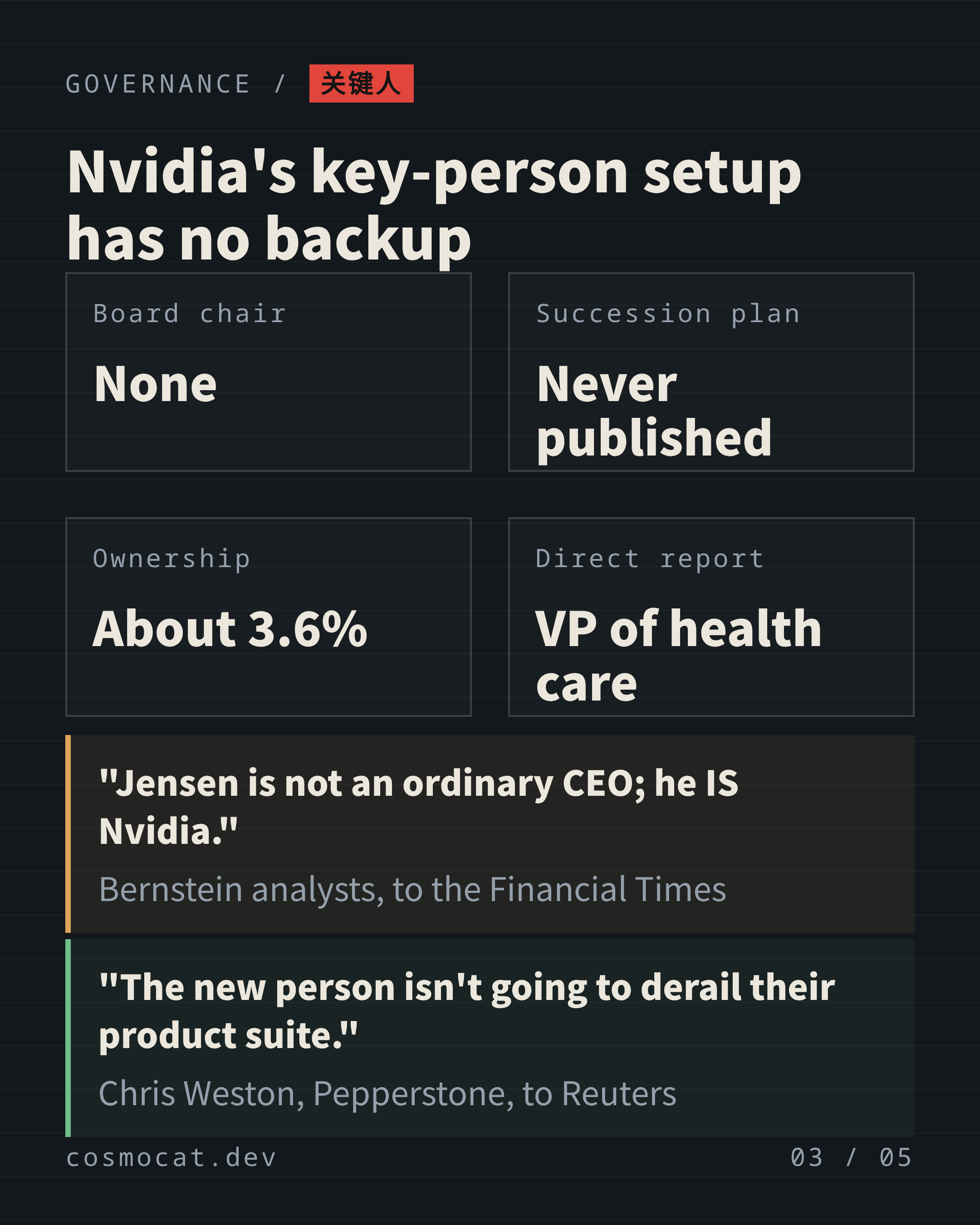
There is a governance detail that gets lost. Nvidia's board has no chair. The company has never published a succession plan. Huang owns about 3.6% of the stock, not enough to control a vote, yet he is effectively the company's public identity. Bernstein analysts told the Financial Times that Jensen is not an ordinary CEO, he is Nvidia. Chris Weston of Pepperstone told Reuters the other side, that a new person would not derail the product suite.
Both are true. They differ on time scale. Over twelve months, the products, the orders and the CUDA ecosystem stay on their rails. Over five years, someone has to decide the next architecture, allocate capital and choose which customers to build around. No second person has done those jobs.
The Times piece on November 10 was not really about the affair. It quoted governance experts asking whether this board had been too deferential to a CEO who built a four-trillion-dollar company. That question is academic in normal times. Once an investigation starts, it becomes a procedural one.
The November 8 statement used the phrase "no reason to believe." That is a careful, narrow legal formulation. It answers whether secrets were lost. It does not answer a softer question, whether a private relationship between a manager and a direct report could shape his judgment on people, budgets and customer relationships. The second report is dangerous because it moves the issue from whether something leaked to whether there was a conflict of interest. The second question does not need an intelligence agency to answer it.
The other story moved the cost of switching
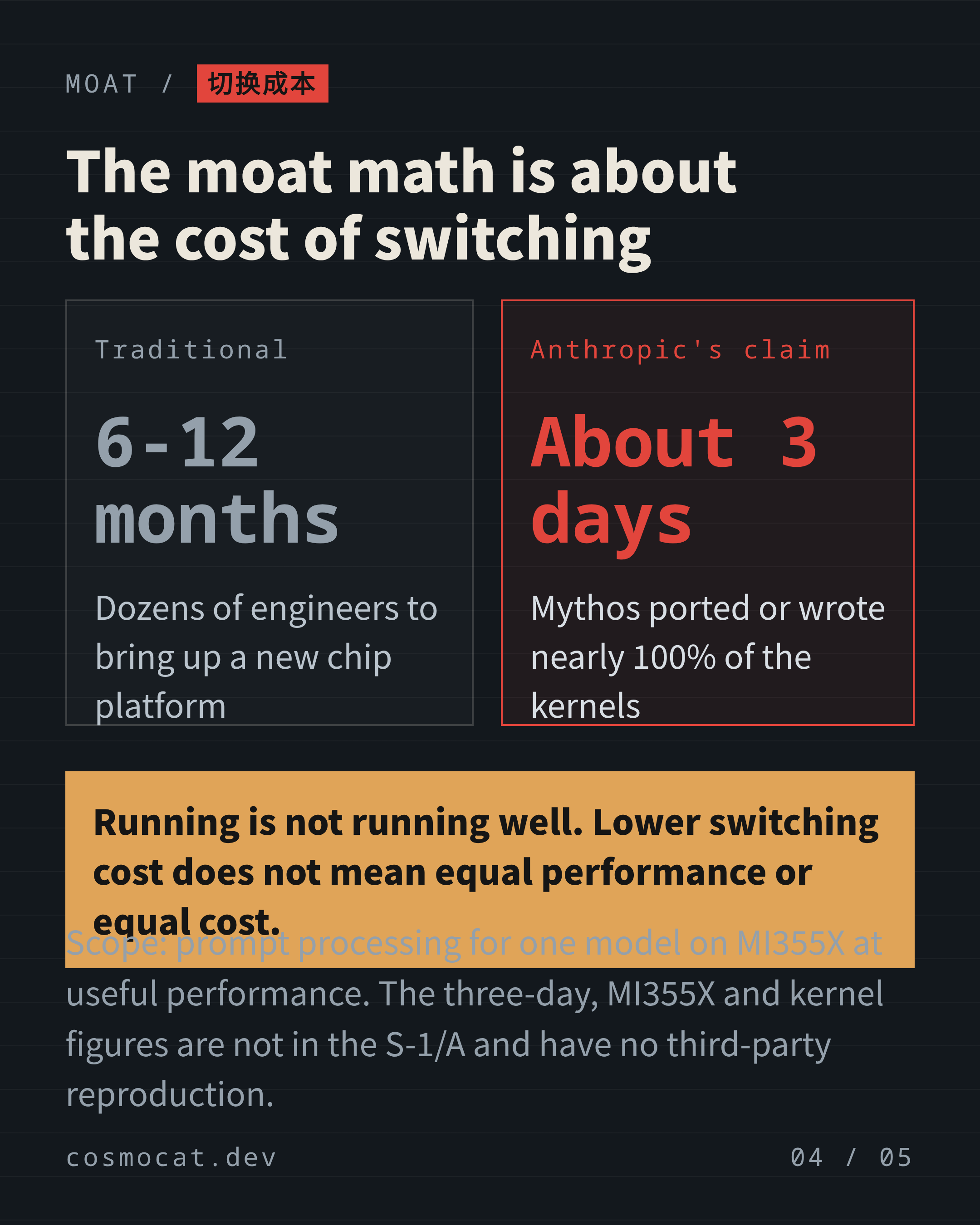
On November 10, Anthropic published a 42-minute IPO roadshow video. In the compute chapter, co-founder Tom Brown said the company used AMD GPUs for the first time this year. It handed the job to its own model, Mythos. Claude was running in about three days with almost no human intervention, and the model ported or wrote nearly 100% of the kernels it needed. Bringing up a new chip platform used to take dozens of engineers six to twelve months.
A footnote on the slide narrows the claim. The three days refers to Claude Mythos Preview bringing prompt processing for one Anthropic model up to a useful level of performance on AMD MI355X chips. The six-to-twelve-month figure is the company's own historical experience with traditional engineering. Anthropic published no throughput, no latency and no comparison with Nvidia's current parts.
More importantly, the numbers are not in the prospectus. Anthropic's November 10 S-1/A says it trains and serves Claude across AWS Trainium, Google TPUs, Nvidia GPUs and AMD GPUs, and that Claude can bring a new platform into production in a fraction of the time this once required. The filing does not contain three days, MI355X or a kernel percentage. The roadshow slide is marketing. The S-1 is a legal document.
That does not make the claim unimportant. The CUDA moat is a switching-cost moat. Benchmark scores are not the point. The point is how much code has to be rewritten, how many engineers retrained, how many pipelines revalidated when a customer changes hardware. Three days against six to twelve months attacks that cost. It does not prove MI355X matches Nvidia's flagship, and it does not prove unit costs are lower at scale. Running is a long way from running well.
But if the switching cost falls even by half, the customer's leverage at the negotiating table changes. AMD rose more than 8% that day. Nvidia fell more than 6%. The market voted on the direction first.
Two single points repriced in one week
Put the two stories together and Nvidia's valuation has been resting on two single points. One person. One software ecosystem.
For a decade, both were treated as certainties. Huang was the company's narrative. CUDA was the ground customers could not leave. Certain assets are not usually hurt by bad news so much as by a change in the discount rate applied to them. Once that repricing starts it is fast, because so many people own the stock and nobody wants to be last out.
A person can be repriced in an afternoon. The board meets, issues a statement, and the price resets. A chip ecosystem takes quarters. Customers have to move real orders, third parties have to publish benchmarks, and two or three earnings reports have to confirm the shift. That is why, on the same day, the story about a person produced a 7% after-hours drop while the story about a chip produced an 8% gain in AMD.
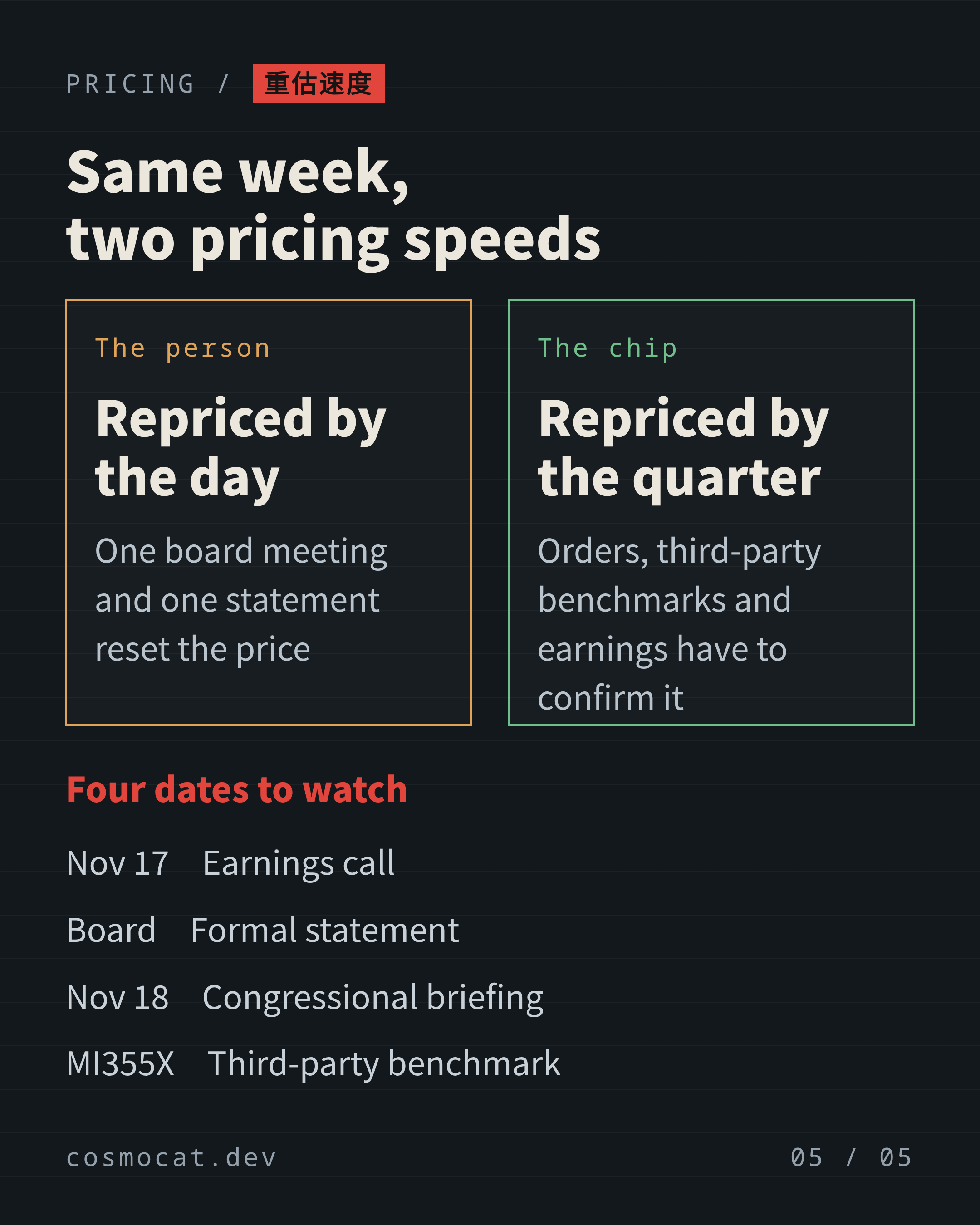
Four dates will tell us more.
The November 17 earnings call, where investors will watch whether Huang attends and whether management is pressed on governance. The board's formal announcement, if there is one, and whether it repeats its confidence or starts a transition. The November 18 congressional briefing, where the question is whether the inquiry moves from a private relationship to chip flows. And any third-party benchmark from AMD or Anthropic on MI355X, which would move the three-day claim from a roadshow slide into something reproducible.
The first two decide the discount on the person. The last two decide the discount on the chip.
Beyond the position
If you own Nvidia, watch governance in the short term and orders in the medium term. Governance risk arrives quickly and leaves quickly once the board states a clear conclusion, and the discount can close. Order risk arrives slowly. If customers write an interchangeable compute pool into their procurement strategy, the drawdown becomes structural.
If you do not own it, the week is still worth studying. It put two questions on the table that normally hide in the notes to the financial statements. How should a market price key-person risk, and how deep is a software ecosystem moat. Nobody runs those numbers in calm times. In a crisis the market did the first in a day and will spend several quarters on the second.
Nvidia's story for a decade has been that the people selling shovels are the safest ones in a gold rush. This week showed that shovel sellers have two soft spots, one in the boardroom and one in the customer's switching-cost spreadsheet. Both were always there. This time they were visible at once.
This is not investment advice. Prices and moves are from the November 11, 2026 U.S. close and after-hours session. The market-value figure follows Reuters. The second relationship and the removal report rely on anonymous media sources and have not been confirmed by the company or the people named.
Sources
- The New York Times, 2026-11-11, Jensen Huang Said to Have Had Relationship With Nvidia Executive Who Reports to Him
- CNBC, 2026-11-11, Nvidia prepares to oust Jensen Huang, WSJ reports
- Reuters via Yahoo Finance, 2026-11-11, Nvidia board meets to decide CEO Huang's future, source says
- TechCrunch, 2026-11-11, Jensen Huang accused of having another affair with a Nvidia exec
- The Decoder, 2026-11-11, Anthropic says AI is eroding Nvidia's CUDA lead
- Anthropic IPO site, roadshow video and captions, https://ipo.anthropic.com/
- CellCog, 2026-11-11, Anthropic roadshow video claims on AMD and disease